
Buying clothes
Koreans love to shop. Korea’s post-war economic boom sparked a consumer culture second-to-none, especially in big cities like Seoul, where you’ll find grand department stores, cavernous shopping malls, high-end luxury shops, traditional outdoor markets, hole-in-the-wall shops and a myriad of other places eager to relieve you of your shopping dollars.
Perhaps unsurprisingly, Seoul is the best place to shop offering Korea’s largest collection of department stores with the widest selection of goods. Busan earns a special mention since it’s home to the world’s largest department store, the gargantuan Shinsegae Centum City. Korean retail culture accommodates shoppers of all budgets.
Vocabulary
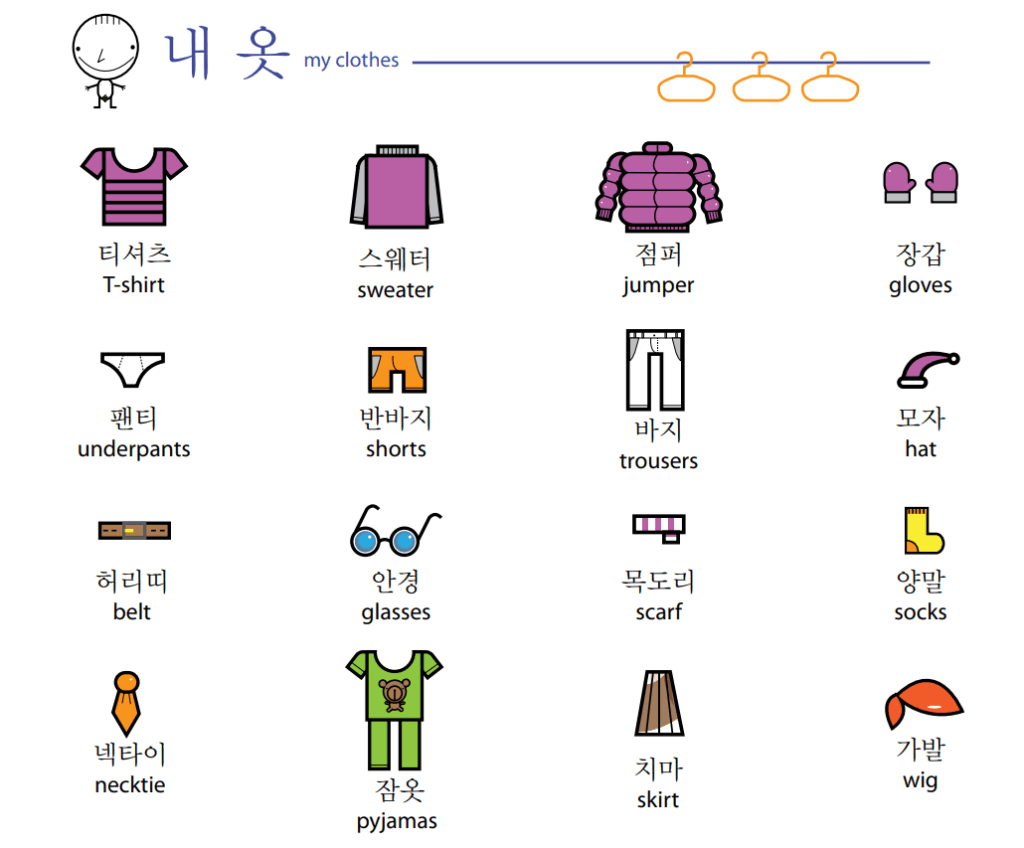
Grammar Points
Noun + 밖에, 만 only
These expressions are the only thing. It corresponds to “only ” or “nothing but” in English. The particles, 밖에 and 만 have similar meanings, but while 만 can be used in a positive sentence, 밖에 is used in a negative sentence.
Noun + 밖에 + negative form
Noun + 만 + positive form
Either 밖에 or 만, it’s up to you which expression you use, but ensure that you put a correct form afterward.
E.g. 사과밖에 없어요. I only have an apple = 사과만 있어요. I only have an apple
E.g. 교실에 재준 씨밖에 없어요. Only Jaejun is in the classroom = 사과만 있어요. Only Jaejun is in the classroom
B 보다 A 더 = more A than B
“보다” indicates that the word preceding it is the standard from which a comparison will be made. It corresponds to ” more… than” or”…er than” in English. While the adverb “더” are generally used together with 보다, they can be omitted.
E.g. 기차보다 비행기가 더 빨라요. Airplanes are faster than trains
– (으)ㄹ 수 있다/없다 can/can’t (long negative form)
This pattern expresses ability and impossibility. When something is possible, – 을 수 있다 is added, and when something is impossible, -을 수 없다 with a verb stem that ends in a consonant. When a verb stem ends in a vowel or ㄹ, “-ㄹ 수 있다/없다” is added.
E.g. 한국어 할 수 있어요. I can speak Korean.
E.g. 한자를 읽을 수 없어요. I can’t read Chinese characters.
You can watch the video which talks about the above grammar points.
Let’s listen!

You are going to listen to Sangmi asking for help buying clothes. Listen carefully and read the translation below. Make a note of new words.
점원: 어서 오세요.
Clerk: Welcome!
상미: 네. 안녕하세요.
Sangmi: Yes, hi!
점원: 뭐 찾으세요?
Clerk: What are you looking for?
상미: 치마요.
Sangmi: I’d like a skirt!
점원: 치마는 여기에 있어요. 여기 보세요.
Clerk: Skirts are here. Please have a look here.
상미: 네. 이거 다른 색깔은 없나요?
Sangmi: Yes, do you have a different colour?
점원: 이건 검정색이랑 빨간색 밖에 없어요.
Clerk: We only have them in black and red.
상미: 이거 입어 볼 수 있어요?
Sangmi: Can I try this one on?
점원: 네. 입어 보세요.
Clerk: Yes, please try it.
상미: 사이즈가 작아요. 더 큰 거 있어요?
Sangmi: It’s small. Do you have a bigger one?
점원: 네. 어떤 사이즈요?
Clerk: Yes, what size?
상미: 허리 27 사이즈요.
Sangmi: Waist size 27.
Let’s practise!

Imagine you are buying clothing at the shop and please talk about No. 2 & 3 like in an example below.

<Example>
가: 저기요. 바지가 좀 짧은 것 같아요.
Ga: Excuse me. I think these trousers are a bit short.
나: 그럼 좀 더 긴 바지를 드릴게요. 잠시만 기다리세요.
Na: Then, I will give you longer trousers. Pls, wait for a moment.
